SSI Earned Income Calculator: How Much Can You Earn?
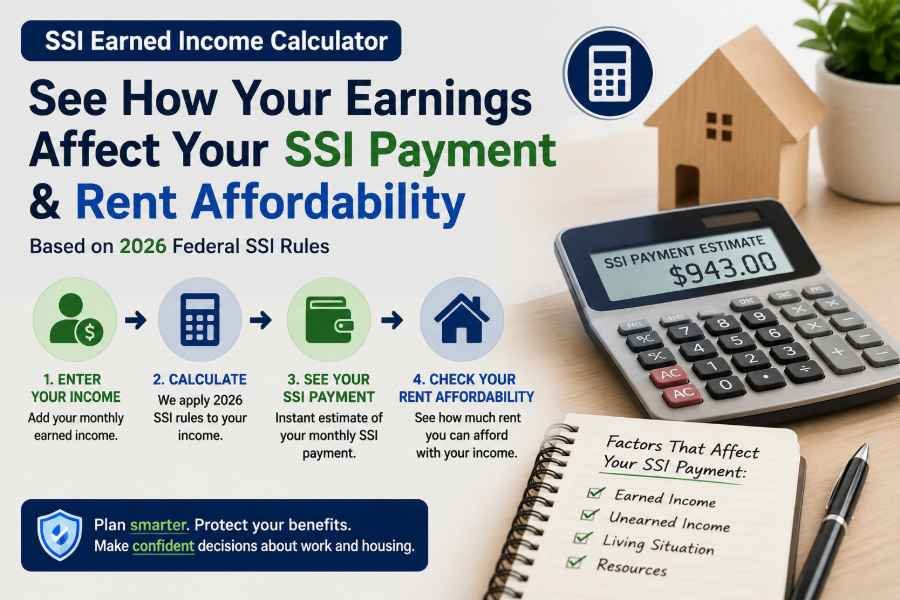
This SSI Earned Income Calculator helps you estimate how working affects your monthly SSI payment, total income, and rent affordability using the latest 2026 federal SSI rules. Earning more almost always leaves you better off, even after your SSI check shrinks. But the math isn't obvious, and guessing wrong can mean an unwelcome surprise. This calculator shows your real numbers: your new SSI payment, your total combined income, and how that stacks up against your rent.
Key takeaways
- Use this SSI Earned Income Calculator to estimate how your wages may affect your monthly SSI payment.
- In 2026, the federal SSI maximum is $994/month for an individual. Your payment is that maximum minus your countable income.
- Because of the earned income exclusion, you can earn roughly $2,000/month from work and still receive a small SSI payment.
What's in this page
SSI Earned Income Calculator
Federal calculation only. State supplements aren't included and can raise your actual payment.
How this is calculated
Social Security doesn't count all of your wages. First, $65 of monthly earnings is excluded automatically (if you have no other unearned income, an extra $20 general exclusion applies here too). Then, half of what's left counts as income. That "countable income" is subtracted from the federal maximum to get your new SSI check.
This is why working almost always leaves you with more money overall, even though your SSI payment goes down. You keep about half of every dollar you earn on top of a shrinking, but real, SSI payment, until your countable income reaches the federal maximum.
The SSI Earned Income Calculator above follows the federal SSI earned income formula to provide a quick estimate based on the information you enter.
SGA vs the SSI earned income limit: two different rules
These two things get mixed up constantly, and they're not the same thing. Substantial Gainful Activity, SGA, is a threshold used mainly to decide whether you're disabled enough to qualify for benefits in the first place. In 2026, that threshold sits around $1,690 a month for non-blind applicants. Earn above it before you're approved, and Social Security can deny your application on medical grounds alone.
The SSI earned income formula in the calculator above is different. It applies once you're already receiving SSI, and it doesn't cut you off the moment you cross a line. Instead, your payment shrinks gradually as you earn more, using the $65-plus-half-of-the-rest formula, all the way down to zero around $2,073 a month for an individual. The SSI Earned Income Calculator uses the federal earned income formula after you're already receiving SSI. It estimates how your payment gradually changes as your earnings increase.
In plain terms: SGA is mostly an approval gate. The earned income formula is an ongoing, gradual reduction. Confusing the two is exactly why so many people assume they'll lose everything the moment they earn "too much," when in reality SSI usually shrinks slowly, not all at once.
A worked example, step by step
Say you're an individual receiving SSI, and you pick up part-time work earning $1,015 a month, with no other income.
Here's an example showing exactly how the SSI Earned Income Calculator estimates your new SSI payment.
- Start with your $1,015 in wages.
- Subtract the combined $85 exclusion ($65 earned income exclusion plus the $20 general exclusion, since you have no unearned income): $1,015 − $85 = $930.
- Count half of what's left: $930 ÷ 2 = $465. That's your countable income.
- Subtract that from the federal maximum: $994 − $465 = $529. That's your new SSI payment.
- Add your wages back in: $529 + $1,015 = $1,544 total monthly income, up from $994 before you started working.
That last step is the part worth sitting with. Even though the SSI check dropped by $465, total income went up by $550. Working paid off here, it just didn't feel that way looking at the SSI check alone.
What counts as income for SSI
The formula above applies to earned income specifically, wages or net self-employment earnings. But SSI also counts unearned income differently, and it's worth knowing the difference since it changes your numbers:
- Earned income: wages, net self-employment profit. Gets the $65-plus-half exclusion used in the calculator above.
- Unearned income: pensions, unemployment, gifts, other Social Security benefits. Only the first $20 is excluded, then the rest counts in full, dollar for dollar.
- In-kind support: free or reduced-cost food or shelter someone else provides. This can count as unearned income too, which is the exact mechanism covered in our SSI roommate rules article.
Self-employment income is treated as earned income, but Social Security typically looks at net profit, not gross revenue, and the calculation can involve additional deductions for business expenses. If self-employment is your main income source, a call to a benefits counselor before assuming your countable income beats a rough estimate.
Reporting your income, and what happens if you don't
SSI requires you to report income changes to Social Security, generally within 10 days of the end of the month the change happened in. This isn't optional paperwork. If you don't report, and Social Security later discovers you were paid more than you were entitled to, that becomes an overpayment, and they will recover it, usually by withholding future SSI payments until it's paid back.
The safer habit: report every income change as it happens, keep pay stubs, and don't wait for your annual review to surface a change you already knew about. It protects you from an overpayment far more than it costs you in a few minutes of paperwork.
Also getting Social Security retirement? Compare claiming ages
This is a separate program from SSI, based on your work record rather than financial need, so none of the earned-income rules above apply to it. If retirement benefits are part of your picture too, see what claiming at 62, full retirement age, or 70 is actually worth. Find your full retirement age estimate at your my Social Security account.
| Claim at | Monthly benefit | Vs. full retirement age |
|---|---|---|
| Age 62 | — | — |
| Full retirement age | — | 100% |
| Age 70 | — | — |
Estimate only, based on standard SSA early/delayed retirement rules. Your actual full retirement age and benefit depend on your full earnings record. Confirm exact figures at ssa.gov.
Common questions
Does this apply to SSDI too?
No. SSDI is based on your work record, not your current income, so this earned-income reduction formula doesn't apply. SSDI has its own separate rules, including a Trial Work Period and a substantial gainful activity threshold. See our SSDI vs SSI comparison for the full breakdown.
Will I lose Medicaid if my SSI drops to zero?
Not automatically. Many states have provisions (often called 1619(b)) that let you keep Medicaid even after your SSI payment reaches zero due to earnings, as long as you remain otherwise eligible. Confirm your state's specific rule with your local SSA office.
What is the Trial Work Period?
The Trial Work Period is an SSDI provision, not an SSI one, that lets you test working without immediately losing benefits. Since this calculator covers SSI's earned income formula, the Trial Work Period doesn't apply here directly.
Does my state add anything on top of the federal SSI amount?
Many states add a supplemental payment on top of the federal SSI rate, which this calculator doesn't include. Your actual payment may be higher than what's shown here. Check with your state's SSI supplement program for your specific amount.
What's the difference between earned and unearned income for SSI?
Earned income is wages or net self-employment profit, and it gets the more generous $65-plus-half exclusion. Unearned income, like a pension or gift, only gets a $20 exclusion before counting in full. The type of income you have changes your countable income significantly.
Does self-employment income count the same way as a paycheck?
It's still treated as earned income, but Social Security generally looks at net profit after business expenses, not gross revenue, and the calculation can involve extra deductions. If self-employment is a significant income source, confirm your specific numbers with a benefits counselor rather than relying on a rough estimate.
What if my income changes every month?
Report each change as it happens rather than waiting for a review. Social Security calculates your SSI payment month by month based on your actual reported income, so irregular earnings mean your payment amount can shift from month to month too.
Sources
Social Security Administration: Working While Disabled · SSA: SSI Federal Payment Amounts
This calculator gives a general federal estimate only and isn't legal or financial advice. State supplements, deeming rules, and individual circumstances can change your actual payment. Confirm your specific numbers with the Social Security Administration before making employment decisions.