Can You Get Section 8 on SSDI?
Yes, SSDI qualifies for Section 8 in 2026. Here are the income limits, the deductions most households miss, and the full rent-share math.
By Kartik Sharma · Can I Afford My Rent · Updated November 6, 2026
The Quick Answer
Section 8 never asks where your income comes from. It asks how much of it there is and whether it sits under your county's limit. Renters on SSDI qualify for a Housing Choice Voucher at the same income test as renters on any other income, with two advantages built in: disability deductions that shrink your countable income, and (at many housing authorities) waitlist preferences for disabled applicants.
If part-time earnings sit on top of a benefit, our SSI earned income calculator shows how extra wages change it.
So the plain answer to "can you get Section 8 on SSDI" is yes: the income bar clears in most counties, the deductions help, and the waitlist is the real fight.
How Section 8 Decides Who Qualifies
Every housing authority (PHA) sets eligibility from area median income (AMI) for its county or metro area. HUD publishes these income limits once a year, and FY2026 limits came out May 1, 2026.
| Income tier | Threshold | What it means |
|---|---|---|
| Extremely low income | ≤ 30% of AMI | 75% of new vouchers must go here |
| Very low income | ≤ 50% of AMI | The standard Section 8 ceiling |
| Low income | ≤ 80% of AMI | Eligible for some programs, hard to get a voucher |
Most applicants qualify at 50% AMI or below. If you're on SSDI alone, your odds look like this: the average benefit ($1,630 per month, per the SSA's 2026 COLA fact sheet) totals $19,560 a year, which sits under the very-low-income line in most of the country.
Check your exact county with the HUD income limits tool. The number moves a lot: a one-person household might face a $30,000 ceiling in an ordinary metro and a $55,000-plus ceiling in a high-cost one.
Does SSDI Count as Income for Section 8?
Yes, every dollar of it. HUD counts your gross SSDI benefit, the amount before Medicare premiums come out, and our full breakdown of whether SSDI counts as income covers where that rule comes from. If your check reads $1,630 gross with $185 in premiums deducted, Section 8 counts $1,630.
Two reasons people get this wrong on their application:
- Reporting net income (after Medicare) makes you look poorer than HUD rules allow, and PHAs verify against your award letter anyway, so the correction slows you down.
- Reporting only the 2025 amount after your January raise creates an income discrepancy the PHA must chase during verification.
Copy the gross figure straight off your award letter. That's the whole job.
Your Rent Share: the 30% Math That Actually Matters
Once you hold a voucher, you generally pay about 30% of your adjusted monthly income toward rent and utilities, and the PHA pays the landlord the rest up to the local payment standard.
"Adjusted" is where disabled households win. Before the 30% is applied, 24 CFR 5.611 lets the PHA subtract:
- A flat deduction for elderly or disabled families, $525 a year in current HUD schedules
- Unreimbursed medical expenses exceeding 3% of annual income (for elderly or disabled households)
- Attendant care and auxiliary apparatus costs for a household member with a disability
Worked Example: SSDI at the Average Benefit
Here is the calculation most guides skip. Single renter, only income is the average 2026 SSDI check.
| Step | Figure (2026) |
|---|---|
| Gross monthly SSDI | $1,630 |
| Annual income (×12) | $19,560 |
| Less disabled-family deduction | −$525 |
| Subtotal | $19,035 |
| Unreimbursed medical costs (example) | $2,400/year |
| Medical deduction (everything above 3% of $19,035, that is $571) | −$1,829 |
| Adjusted annual income | $17,206 |
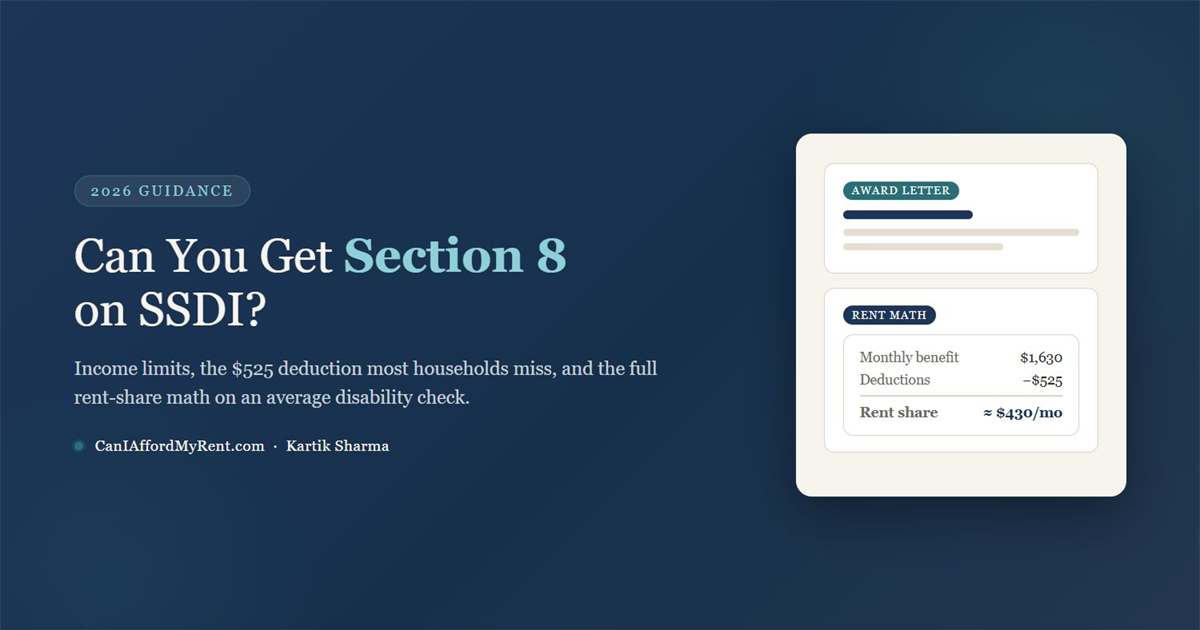
| 30% of adjusted income, divided by 12 | ≈ $430/month rent share |
So a renter with the average SSDI check lands near $430 a month for rent and utilities combined, before the utility allowance knocks it lower in most places. Your result depends on your actual expenses, and the PHA computes several formulas and applies the rules to the lowest total. Some PHAs set a minimum rent, and federal law caps that minimum at $50.
Report the medical bills. A household that skips the medical-expense line because "it's only $2,000" pays for that modesty every month, in rent.
The COLA Problem Nobody Warns You About
Your SSDI got a 2.8% raise in January 2026 (and whether the raise is taxed is its own question). Your Section 8 rent share is rebuilt from your income, and a raise triggers a recalc, usually through an interim redetermination.
Three practical moves:
- Report the COLA increase to your PHA when it happens, in January, rather than waiting for your annual review to discover it.
- Expect your rent share to rise a few dollars (roughly $1 in rent for every $3.33 of monthly raise, at the 30% ratio) while your benefit rose more.
- Recertify your medical expenses at the same time. Medical costs usually grow each year too, and they subtract directly from countable income.
The raise always outruns the rent increase. Reporting promptly keeps your file clean, and unreported changes are the leading reason PHAs open compliance reviews.
How to Apply, in One Pass
- Find the PHA that serves your county (HUD's PHA contact list at hud.gov).
- Ask whether the waitlist is open. Many run closed for years; some open only for a few days a year.
- Ask specifically: "Do you have a disability preference, and do you administer NED or Mainstream vouchers?"
- Gather documents: photo ID, Social Security numbers for the household, SSDI award letter, 2 to 3 months of bank statements.
- Apply the day the list opens, and log in monthly to keep your contact info current.
The Waitlist, and Two Shortcuts Worth Knowing
The wait is the program's tax. Big-city lists commonly run 2 to 5 years. Two things can shorten yours:
Disability preferences. Many PHAs score applicants with local preferences, and disability is one of the more common ones. This moves you up, and it costs you only a sentence at intake: state that you have a disability.
Set-aside vouchers. HUD funds Non-Elderly Disabled (NED) and Mainstream vouchers specifically for disabled households. NED vouchers (roughly 55,000 nationally) generally serve people 18 to 61, and Mainstream vouchers help disabled households at risk of institutionalization. Either can bypass the general line entirely at some authorities.
Public housing is the same PHA usually managing a parallel voucher-style program with income-based rents and often shorter lists. Section 811 supportive housing serves disabled households with services attached, through state housing agencies. LIHEAP offsets utility bills in the meantime.
Can the Voucher Cut Your SSDI? (Read This If Your Income Is SSI)
A Section 8 voucher cannot touch your SSDI amount. HUD pays the landlord; SSA sees none of it in the SSDI calculation. The two systems don't talk about SSDI checks at all.
SSI is a different machine, and the confusion is understandable because the two benefits read almost alike in most guides. If some of the household's income is SSI: paying your own rent from an SSI check does not reduce the benefit, free or heavily subsidized housing can, and federal rental assistance such as Section 8 is specifically excluded from SSI's in-kind support rules. Our SSI roommate rules guide covers the living-arrangement rules in detail, and this explainer untangles which benefit you're holding in the first place.
Frequently Asked Questions
Does SSDI count as income for Section 8?
Yes. For Section 8 on SSDI, the counted income is your gross benefit before Medicare premiums. Report the number printed on your award letter, not your bank deposit.
Can you get Section 8 with only SSI income?
Yes, almost always on the income test. The 2026 maximum federal SSI benefit is $994 a month for an individual (about $11,928 a year), which sits below the very-low-income line in essentially every county. Your obstacle will be the waitlist, and your deduction advantage is real: at $994 monthly income, a voucher rent share often lands near $285 a month or less, before any medical deductions.
Will Section 8 reduce my SSDI payment?
No. The voucher is paid to the landlord, and SSA excludes federal rental assistance from any SSDI calculation. SSI cases have separate living-arrangement rules, covered in the section above.
What SSDI amount is too high for Section 8?
No national cutoff exists. The ceiling is 50% of your county's area median income, so the answer ranges from about $30,000 to $55,000-plus for a one-person household depending on location. Run your county through the HUD income limits tool.
Do disabled applicants get priority on the Section 8 waitlist?
At many PHAs, yes, through local disability preferences. Nothing is automatic; you claim it at intake with your award letter. NED and Mainstream set-aside vouchers are the stronger shortcut where your PHA administers them.
How long is the Section 8 waitlist for SSDI recipients?
Two to 5 years in high-demand metros, sometimes under a year in smaller markets, and applying to every adjacent PHA's list is standard practice precisely because they differ that much.
Does my COLA raise change my Section 8 rent?
Yes. A 2.8% SSDI increase (January 2026) lifts your countable income and your rent share rises from 30% of the increase, roughly a dollar of rent per $3.33 raised. Report it promptly to avoid a compliance flag, and refile your medical-expense numbers at the same time.
So, can you get Section 8 on SSDI?
SSDI clears the Section 8 income bar in most counties. Your rent share lands near 30% of adjusted income after the disability and medical deductions, your benefit itself is untouchable, and the two levers that move you fastest are claiming the disability preference at intake and applying to multiple PHA lists at once.
© 2026 Can I Afford My Rent · Written by Kartik Sharma · Program rules and limits vary by county and year; confirm details with your local PHA.